
The Association for Elections and Democracy (Perludem) and a coalition of civil society organizations met with the National Awakening Party (PKB) to urge the swift deliberation of the Election Bill. The discussion highlighted key issues, including the electoral system, disability voter data, regional election financing, youth and women’s representation, and the digitalization of elections, all of which are expected to inform the ongoing legislative process.
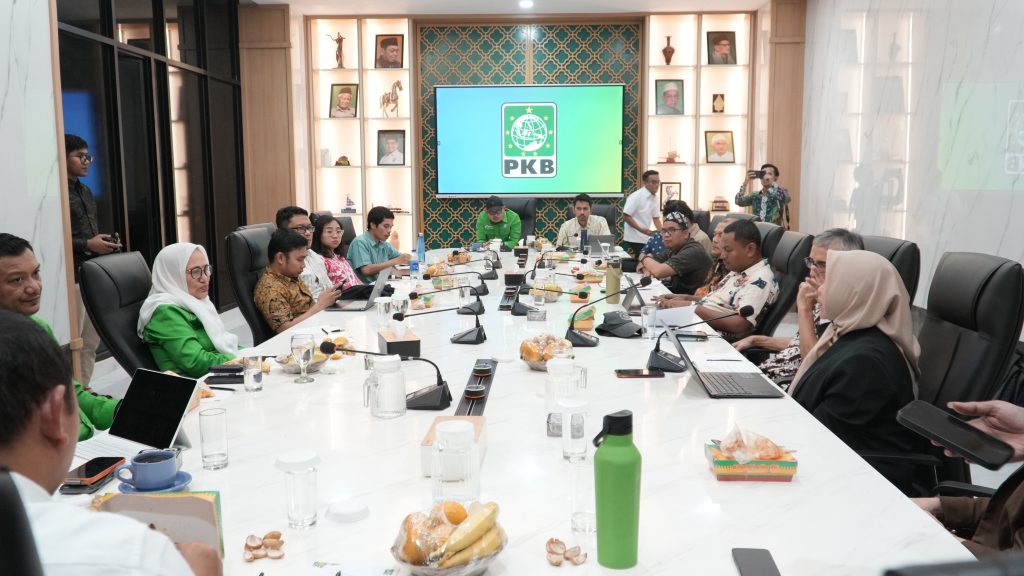
Jakarta — Perludem, together with a civil society coalition advocating for the codification of the Election Law, held a hearing with the National Awakening Party (PKB) to push for the swift deliberation of the draft Election Bill (RUU Pemilu). The meeting served as a platform for civil society organizations (CSOs) to present a range of strategic and technical recommendations on the proposed election law revision, which they consider urgent for the House of Representatives (DPR) to address without delay.
The session was opened by PKB Secretary-General Hasanuddin Wahid, who expressed appreciation for the presence of CSO representatives in providing input on the Election Bill.
Electoral System Takes Center Stage
Perludem Executive Director Heroik M Pratama opened the substantive discussion by outlining several major issues in the Election Bill, ranging from the choice of electoral system to its various consequences.
In a similar vein, Netgrit Executive Director Hadar Nafis Gumay explained the mechanism for selecting election organizers and laid out electoral system options, including the Mixed Member Proportional (MMP) scheme and its implications for the delineation of electoral districts. Hadar also stressed the importance of improving the election information system, starting with fixes to Sirekap, the vote recapitulation application.
Titi Anggraini, a constitutional law scholar from the Faculty of Law, Universitas Indonesia, underscored the urgency of accelerating deliberation on the Election Bill. She noted that the selection process for election organizers is set to begin soon, warning that delays in passing the bill could create confusion for election administrators.
Disability Voter Data and Regional Election Financing
Happy Sebayang, a representative from PPUA Disabilitas (the Election Access Center for Persons with Disabilities), highlighted inconsistencies in voter data for persons with disabilities. According to Happy, PPUA Disabilitas’ internal data records around 18 million people with disabilities nationwide, a figure not reflected in the official voter list. He noted that even people with physical and visual disabilities are often not registered as disabled voters. As a result, he said, special accommodations such as braille ballots become difficult to provide due to inaccurate data.
Eduard from the Regional Autonomy Watch (KPPOD) raised concerns over the ongoing debate regarding regions’ inability to allocate sufficient regional budget (APBD) funds for local election financing. He recommended establishing a Special Allocation Fund (DAK) for local democracy, financed by the central government, as a consequence of the national-local election framework — particularly given that regional elections will simultaneously cover both provincial/district legislative (DPRD) elections and regional head elections, costs which he argued should partly be borne by the central government.
Meanwhile, Angel from Kawula 17 raised concerns about youth engagement, pointing to the lack of platforms offered by political parties and the absence of discussion on issues that matter to young voters within the Election Bill.
PKB’s Response
Responding to the input, PKB Secretary-General Hasanuddin Wahid reaffirmed the party’s commitment to candidates with disabilities. He noted that PKB currently has several cadres with disabilities serving as provincial and district/municipal legislative council members, with some even holding positions as chairs of the party’s local branch leadership (DPC).
Muhammad Khozin, a member of the House Commission II from the PKB faction, outlined the current progress of the Election Bill’s deliberation in parliament, including the interplay between parties on contested issues such as the choice between closed- and open-list proportional systems, as well as the parliamentary threshold.
Zainul Munasichin, a PKB member of the House representing West Java Electoral District IV, said further discussion on the electoral system is needed and requested technical input from Perludem on the most suitable system options.
Fellow PKB cadre Anna Mu’awanah, also a House member and former Regent of Bojonegoro, weighed in on the debate over regional election budget allocations from the APBD. She noted that if the Ministry of Home Affairs (Kemendagri) issues a directive on the matter, regions would essentially have no choice but to comply.
- Hanif Dhakiri, PKB Deputy Chairman and a House member representing Central Java Electoral District X, emphasized the need for a more objective, technical-level study of the electoral system — particularly on how vote-to-seat conversion methods affect fairness among parties. On the issue of women’s and youth representation, Hanif noted that the main obstacle is not a lack of opportunity but a reluctance among women and young candidates to take the risk, even though PKB has already provided them with quotas or slots. He also touched on election digitalization, saying that moving directly to e-voting remains too complex at this stage. He proposed that initial efforts focus on strengthening the e-recap (electronic recapitulation) system, accompanied by the development of a clear digitalization roadmap.
Closing
The hearing reflects one of the civil society coalition’s ongoing efforts to press the DPR — and PKB as one of its constituent parties — to promptly deliberate and finalize the Election Bill. The range of issues raised, from the electoral system and disability voter data to regional election financing, women’s and youth representation, and election digitalization, are expected to serve as serious considerations in the legislative process ahead.
Kahfi Adlan Hafiz
Program Manajer Perkumpulan untuk Pemilu dan Demokrasi (Perludem)