
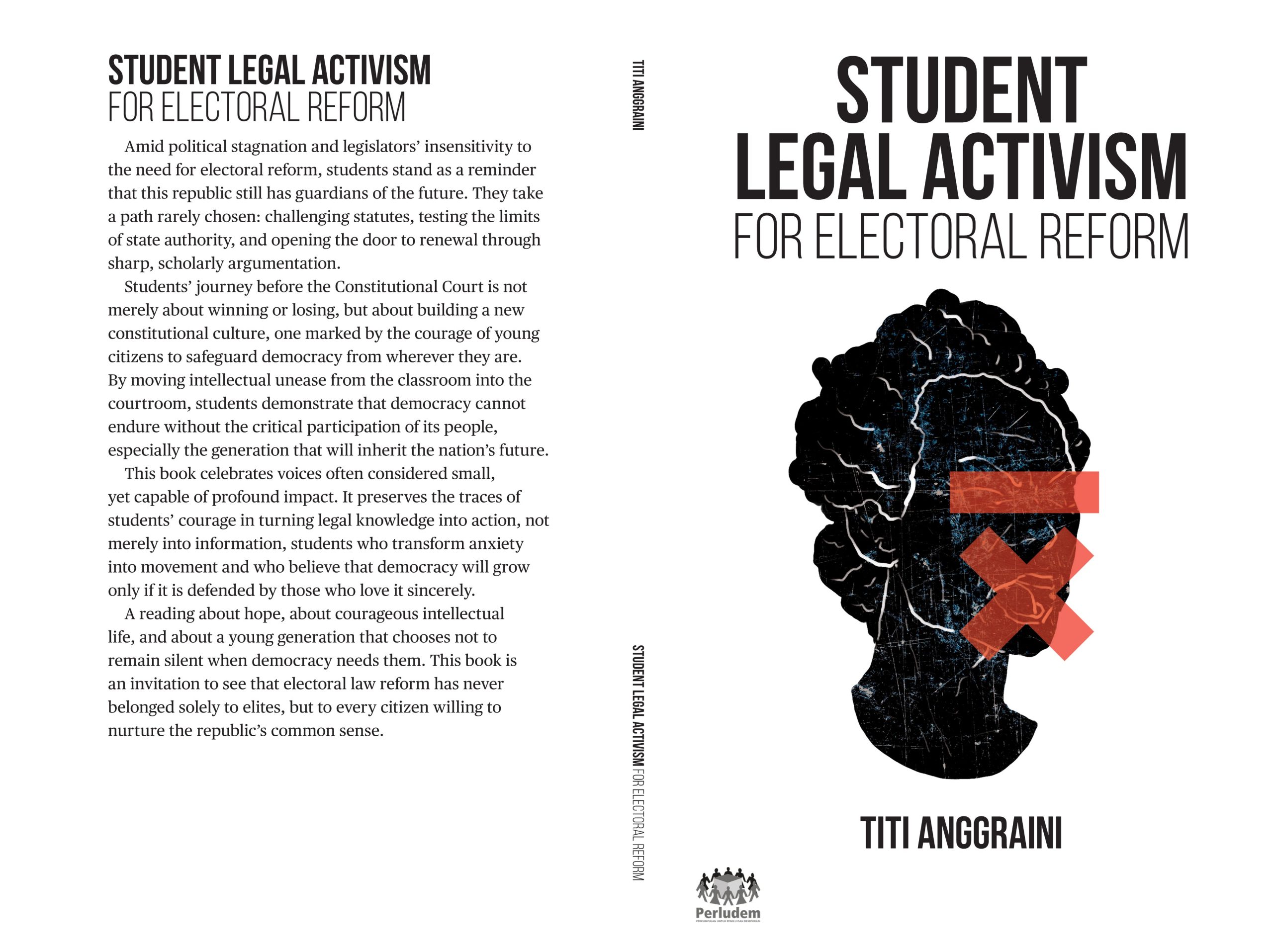
This book marks a new chapter in the journey of constitutional democracy in Indonesia by highlighting the rise of student legal activism that uses the constitutional review process at the Constitutional Court (MK) as a medium for struggle. This phenomenon shows that students are no longer just spectators or critics of public policy, but have transformed into constitutional actors who are helping to write the history of electoral law reform.
The author starts from the belief that democracy will not grow without the active involvement of young citizens who are legally aware, dare to think critically, and are ready to defend their ideas before the highest law of the land, namely the constitution. Using a reflective and documentary approach, this book records the intellectual journey and moral struggle of students who took the constitutional route to correct electoral law inequalities, defend the principle of electoral justice, and uphold people’s sovereignty through the judicial review mechanism at the Constitutional Court.
This book is organized systematically. The first part describes the relationship between students, democracy, and constitutional awareness, including a discussion of the paradox of democracy, the legal architecture of elections, and the importance of recognizing the legal standing of individuals. The author shows that students have a constitutional position to become petitioners in the testing of laws, because they are citizens who are directly affected by systemic injustices in the implementation of elections.
The main part of this book presents documentation and analysis of various constitutional cases filed by students, particularly during the 2023–2025 period. These include cases concerning the implications of holding elections and regional elections in the same year, the threshold for presidential candidacy, the ban on campaigning on campus, and the legal disharmony between the Election Law and the Regional Election Law. Each case is reviewed not only from the perspective of the verdict, but also from the context of the ideas, learning process, and constitutional values fought for by the petitioners. Through this analysis, the author emphasizes that the students’ move to the Constitutional Court is not a form of resistance against the state, but rather an intellectual expression that matures democratic practices.
The next section offers practical guidance for students who wish to pursue a similar path. Based on the real experiences of applicants, the author has compiled seven tips and strategies for appearing before the Constitutional Court. These range from identifying valid constitutional issues, constructing solid legal arguments, and understanding the procedural law of the Constitutional Court, to maintaining integrity and ethics during the trial process. The author emphasizes that the Constitutional Court’s courtroom is not a place for experimentation or popularity contests, but rather a forum that demands mature thinking, careful argumentation, and a moral commitment to constitutional values.
The closing section of the book emphasizes that students have an important role in maintaining a “living constitution.” Through their active involvement, campuses function as laboratories of citizenship where democratic values are practiced and tested. The author highlights the importance of adapting legal higher education so that it not only emphasizes textual and procedural aspects, but also shapes a generation of jurists who have ethical awareness and social responsibility.
This book includes testimonials from student petitioners, who provide personal perspectives on their motivations, struggles, and reflections at the Constitutional Court. In addition, examples of judicial review petitions with individual students’ legal standing are included as academic references and practical learning models for law students throughout Indonesia.
Through the book “Student Legal Activism for Electoral Reform,” the author presents an important narrative about democracy that grew from the lecture hall, was fought for in the courtroom, and was returned to the people. This book is not only a historical record of the courage of students who filed cases with the Constitutional Court, but also an intellectual manifesto that legal change can come from the voices of young people who are constitutionally aware. In the hands of students, the constitution is no longer a frozen text, but a living tool for upholding justice and strengthening Indonesian democracy.
