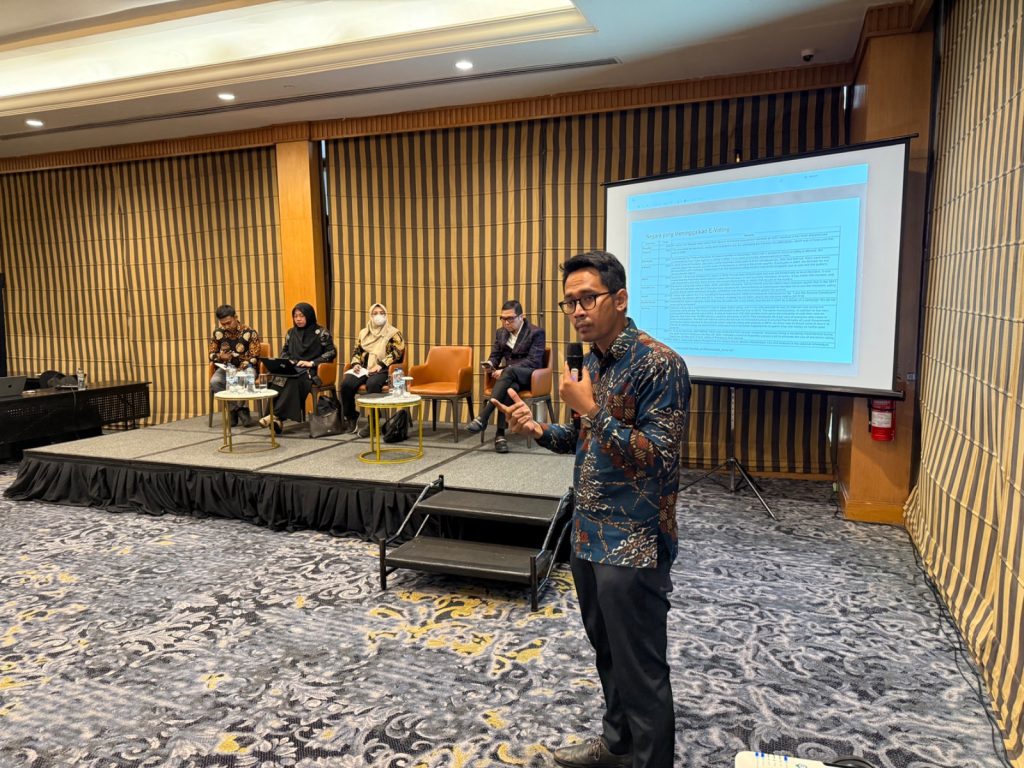
The Association for Elections and Democracy (Perludem), in collaboration with the Center for Constitutional Studies (Pusako) at Andalas University, took part in the Constitutional Law Conference (KNHTN) through a seminar titled “Assessing the Constitutionality of E-Voting in Indonesia” in Jakarta on Monday (14 September 2026). The discussion explored the prospects of adopting electronic voting technology from the perspectives of electoral administration needs, constitutionality, system readiness, security, and oversight.
Perludem Executive Director Heroik M. Pratama said the adoption of technology for voting and vote counting should begin with the problems that need to be addressed, rather than simply with the technology to be used. According to Heroik, the experience of the 2019 and 2024 Elections demonstrated the heavy workload faced by election administrators, creating room to consider various technological alternatives.
“However, the technology chosen must still be tailored to Indonesia’s needs and conditions,” Heroik said.
Heroik explained that experiences from various countries show that there is no single model for implementing e-voting. India and Brazil, for example, have experience using voting technology based on their respective designs and contexts. Meanwhile, several countries have previously used or developed e-voting but later discontinued it, including Finland, Ecuador, Ireland, Germany, Japan, Nepal, the Netherlands, Norway, Pakistan, and Romania.
Therefore, Heroik said, the implementation of e-voting in Indonesia cannot be separated from the fundamental principles governing elections. Any technology used must continue to guarantee elections that are direct, universal, free, secret, honest, and fair.
“If implemented, e-voting must also be assessed against the principles of luber and jurdil as mandated by the Constitution,” he said, referring to the principles of direct, universal, free, and secret (luber), as well as honest and fair (jurdil) elections.
Indonesia, Heroik continued, has never conducted an e-voting trial in an actual election. To date, the use of technology in the electoral process has primarily involved the Recapitulation Information System (Sirekap), which serves both as a supporting tool and as a means of promoting transparency of election results data. If e-voting is to be adopted, Heroik said Indonesia needs clear legal safeguards. Regulations should not merely govern electronic voting procedures, but also guarantee regulatory and system transparency while establishing controls over access to the technology.
“Security must also be ensured, including who holds the access keys, who is authorized to control the system, and how the system will be monitored,” Heroik explained.
According to Heroik, these issues should form part of the ongoing discussion on the codification of the Election Law being advanced by civil society. Regulatory reform provides an important opportunity to ensure that the modernization of elections remains grounded in democratic and constitutional principles.
Modernization Must Be Matched by Readiness
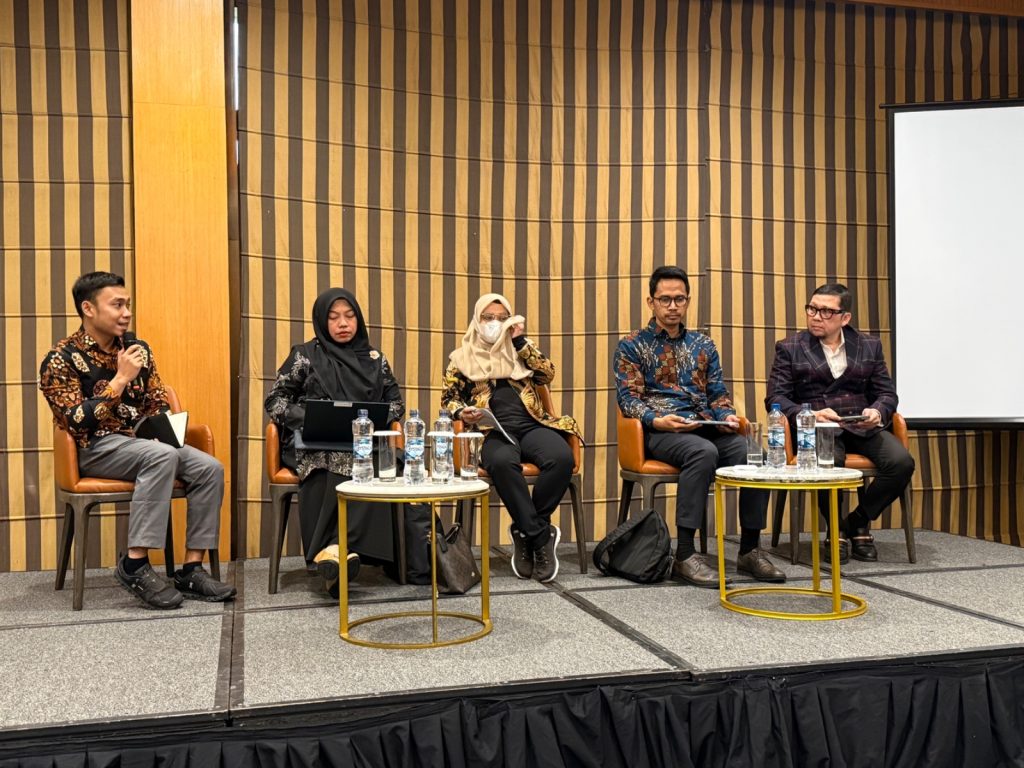
Deputy Chair of the House of Representatives’ Legislative Body (Baleg), Ahmad Doli Kurnia, cautioned against rushing efforts to modernize elections through technology. He said the integration of digital technology should indeed be considered as part of the revision of the Election Law, but must take into account Indonesia’s level of readiness, including the capacity of voters and election administrators to use the technology.
“There are two choices: we can choose to be modern, but face a high risk of failure, or we can keep things simple, which may ultimately produce much more satisfactory results in terms of quality,” Doli said.
Doli highlighted a number of challenges Indonesia continues to face, ranging from gaps in infrastructure and digital literacy to system security. Reliance on digital systems in elections also creates risks of hacking and data breaches that need to be anticipated from the outset. On that basis, Doli said the prospect of implementing e-voting in the near future requires careful consideration. Technological modernization, he stressed, must not come at the expense of the accessibility, security, and reliability of the electoral process.
“Technological modernization must not sacrifice the accessibility, security, and reliability of the electoral process,” he added.
Beyond technological readiness, Doli also emphasized the importance of legal compliance. The modernization of the electoral system will not work optimally if stakeholders lack a strong commitment to complying with the rules that have been agreed upon. The challenge, he said, is particularly complex because elections involve numerous actors with different interests, ranging from political parties and candidates to election administrators and voters.
From an oversight perspective, Bawaslu RI Member Lolly Suhenty said developments in electoral technology must be accompanied by an oversight framework capable of ensuring that constitutional principles continue to be upheld. Discussions on e-voting, she said, need to take into account accessibility, equality, integrity, and ballot secrecy.
Lolly said Bawaslu must not fall behind technological developments in election administration. However, oversight of digital systems cannot stop at procedural checks. The systems used must be subject to comprehensive testing to ensure that technology does not undermine the fundamental principles of elections.
“At least three pillars need to be considered in overseeing e-voting: readiness testing, compliance with electoral principles, and substantive auditability,” Lolly said.
Readiness testing, Lolly continued, needs to be based on clear indicators. One approach would be to develop an index assessing the extent to which a particular region or election administrator is ready to implement voting technology. At the same time, compliance with electoral principles and the ability to conduct audits must be ensured from the outset, rather than after the system has been deployed.
“We must not end up discussing technology while the fundamental principles of elections themselves become the problem,” she said.
Lolly also warned of infrastructure and accessibility gaps that need to be taken into account. People have different levels of access to technology, meaning that e-voting must be designed in a way that does not create inequalities in the exercise of voting rights.
In addition to infrastructure, public digital literacy is another important factor. The use of technology does not automatically make voting easier if voters do not have adequate capacity to use it.
“The efficiency or convenience offered by e-voting cannot be the sole measure for determining whether it is feasible to implement,” Lolly explained.
Constitutional, but Subject to Essential Preconditions
University of Indonesia (UI) Faculty of Law lecturer Titi Anggraini said that, in principle, the implementation of e-votingis constitutionally permissible. However, its implementation must meet a number of preconditions, including guarantees of voting rights, electoral administrative readiness, transparency in auditing, and legal certainty. According to Titi, discussions on e-voting should not begin with the technology to be adopted, but with the problems that need to be addressed in the electoral process.
“Technology is not the goal, but an instrument for addressing specific problems in the administration of elections,” Titi said.
Titi referred to Constitutional Court Decision No. 147/PUU-VII/2009, which opened the possibility of using electronic methods for voting subject to certain requirements. Subsequent Constitutional Court decisions also need to be taken into account to ensure that the use of technology continues to guarantee voter access and the availability of voting methods.
According to Titi, the experience with Sirekap demonstrates that even technology positioned merely as a supporting tool requires accountability mechanisms. Every technological application in elections must have clear operational standards, be subject to scrutiny, and be accountable.
“Technology should not be considered sophisticated while accountability and oversight are left behind,” she said.
Titi said regulations on e-voting should not be left solely to technical regulations such as those issued by the General Elections Commission (KPU). The basic principles governing the use of technology, the limits of election administrators’ authority, and guarantees of voters’ rights need to have an adequate legal basis in legislation.
She also called for the updating of a number of recommendations from studies on electoral technology, including those concerning overseas voters. The readiness of Overseas Election Committees (PPLN), verification mechanisms, the use of photographs of forms as part of the verification process, and clear triggers for transitioning to electronic voting should all be considered from the outset.
If e-voting is ultimately selected, Titi said its implementation should be gradual and measurable. Each stage should allow for scrutiny to ensure that the technology functions as intended and does not diminish voters’ constitutional rights.
According to Titi, the success of electoral technology should not be measured solely by the speed of voting or vote counting. The criteria should include accuracy, reductions in the workload of election administrators, accountability, transparency, protection of voting rights, and cost efficiency.
“The criteria should include accuracy, reductions in the workload of election administrators, accountability, transparency, protection of voting rights, and cost efficiency,” she concluded. []
Ajid Fuad Muzaki
Researcher at the Association for Elections and Democracy (Perludem)