The Association for Elections and Democracy (Perludem) launched the “Guidelines on Eliminating Sexual Violence for Political Parties” in Jakarta on Wednesday (June 17). Developed alongside academics and women’s rights activists, these guidelines aim to reform political parties into safer and more equitable spaces, particularly for women. The event was attended by representatives from nearly all political parties in the DPR (House of Representatives) and DPRD (Regional Legislative Council), including their respective women’s wings.
“Through these guidelines, we aim to foster collaboration with political parties to mainstream gender perspectives while building stronger protections for female politicians,” stated Heroik M. Pratama, Executive Director of Perludem, during his opening remarks at the event themed “Building Safe Spaces in Politics: Lessons and Directions for Strengthening Political Parties in Preventing and Handling Sexual Violence”.
Perludem researcher Annisa Alfath noted that several incidents inherently classified as sexual violence are often normalized. The patriarchal internal culture of parties leads many politicians, including women, to believe that sexual violence is simply an inevitable challenge they must face.
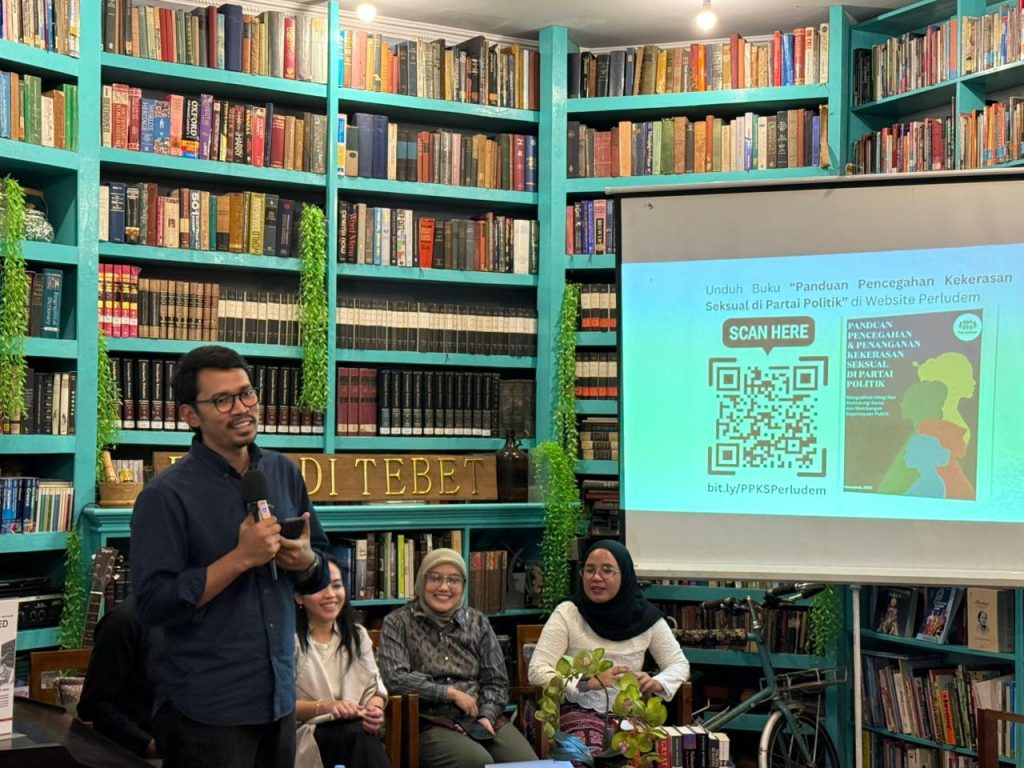
Political Science Academic from the University of Indonesia, Delia Wildianti, explained that transforming political parties into safe spaces for women is an urgent necessity. Beyond the high prevalence of sexual violence within parties, this urgency is heightened by Indonesia’s enactment of the Sexual Violence Crimes Law (UU TPKS). She pointed out that in countries like Australia, passing such legislation prompted political parties to establish internal regulations to address sexual violence.
Furthermore, SAFEnet Executive Director Nenden Sekar Arum highlighted that women in politics also experience electronic-based sexual violence, commonly known as online gender-based violence (OGBV). According to a survey, 75 percent of respondents admitted to witnessing or experiencing online gender-based violence during campaign periods, with 85 percent of the victims being women.
Female politicians attending on behalf of their parties responded positively to Perludem’s initiative. Some even suggested integrating Perludem’s guidelines with existing party frameworks. Several parties shared their experiences in setting up complaint hotlines, conducting gender sensitivity training, and providing legal and psychological counseling for victims. []
USEP HASAN SADIKIN
Researcher at the Association for Elections and Democracy (Perludem)