
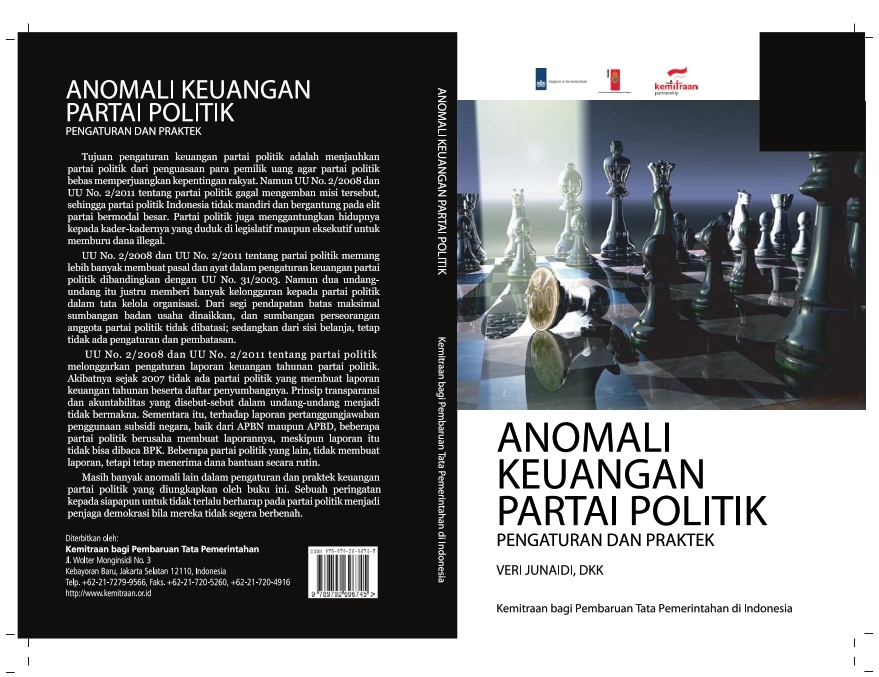
Kemitraan, Perludem, Manikaya Kauci Bali, Kopel Makassar, and Kemitraan Integritas Yogyakarta conducted a study on political party finance regulations as a follow-up to Law No. 2 of 2011 concerning Amendments to Law No. 2 of 2008 on Political Parties (Political Parties Law). The findings of the study were compiled in a research report entitled Political Party Finance Anomalies: Regulations and Practices.
The report examines a number of issues related to political party finance regulations and their implementation in practice. The Political Parties Law imposes strict limitations on sources of party income. At the same time, the officially recognized sources of party financing are highly limited. Regulations governing party finances are restrictive in the sense that they establish limits on virtually every potential source of funding, including individual donations, corporate contributions, foreign assistance, and the establishment of business entities.
Such restrictions are reasonable as a means of preventing financial misconduct and unfair competition among political parties arising from unequal funding. They are also justified given the significant power and influence that political parties exercise over strategic positions within the state, which may create opportunities for the misuse of public resources and financial irregularities.
On the other hand, these stringent regulations have resulted in a limited range of legitimate funding sources for political parties, namely membership dues, donations from individuals and legal entities, and financial assistance from the state budget (APBN) and regional budgets (APBD). At the national level, political parties represented in parliament receive public funding amounting to IDR 108 for each valid vote obtained in an election. Meanwhile, regular membership contributions are generally difficult to collect and are effectively limited to members serving in national or regional legislatures and other executive offices.
At the same time, an assessment of political parties’ operational needs reveals that their financial requirements are substantial. These include the costs of maintaining party secretariats, conducting political education programs, carrying out cadre development and recruitment activities, organizing major party events such as national congresses and assemblies, and financing electoral campaigns in every election.